
You can now read our MCP server before you sign in
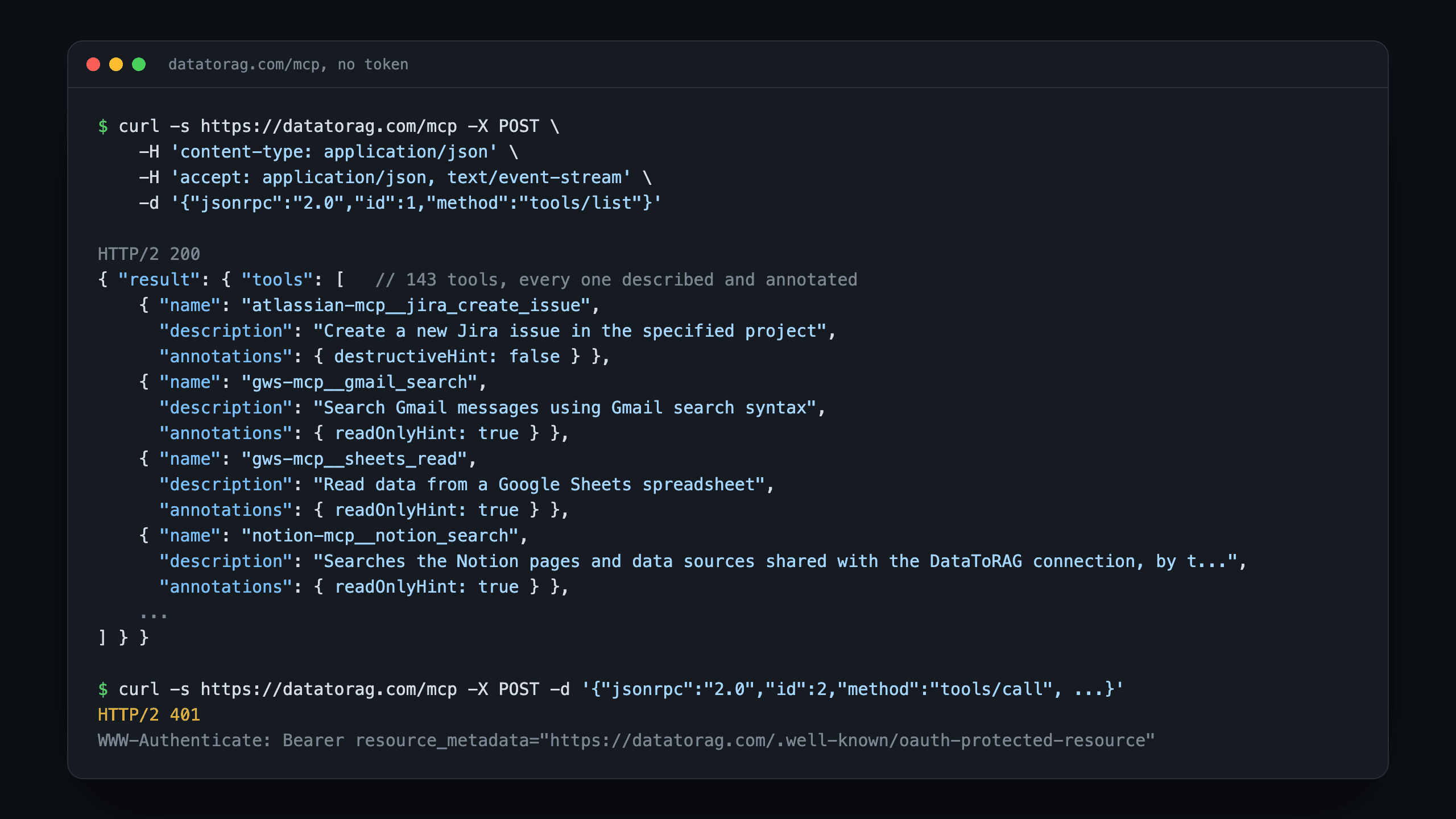
Until this weekend, https://datatorag.com/mcp answered every request without a token the same way: 401, sign in first. That included the two requests an MCP client sends before it does anything useful, the handshake and the tool list. If you were an agent deciding which server to connect to, or a directory indexing servers, you learned nothing about ours until a human had created an account.
That is now changed. The handshake, the tool list, the published skills and a ping all answer without a token. Calling a tool does not.
Why it was closed
The gateway started as a thing I used from my own Claude. Every request carried my token, so the auth check sat at the front door and nothing got past it. When the server went public I kept that shape because it was the conservative one: nothing is served until someone is signed in.
The cost showed up slowly. An MCP client that supports OAuth would connect, get the 401 with our authorization metadata, and start the sign-in flow before the user had seen a single tool name. Directories that probe servers filed us as "needs sign-in" and could not score the tools. Someone evaluating hosted Workspace servers had to sign up to compare.
What is open now
Without a token, the endpoint answers:
initializeand the client'sinitializednotification, the handshakepingtools/list, the public catalogue: the Google Workspace, Atlassian and Notion tools the site lists, plus the gateway's own built-in tools, every one with a description, every argument described, every tool annotatedprompts/list, the published skills
Everything else keeps the 401, with the same WWW-Authenticate header pointing at our OAuth
metadata, so a client that already knew how to sign in sees no difference. That includes every
tool call, batches, and the event stream. An unauthenticated handshake creates no session and
nothing is metered.
The open methods are rate-limited per address. The list they return is the same snapshot the site's tool pages are built from, plus the gateway's built-in tools, so there is no second catalogue to drift.
This is the shape the MCP spec allows and the one Anthropic's connector guidance on lazy authentication describes: discovery open, the gate on the call. We should have shipped it earlier.
What we watch
Open endpoints are a new front door, so they are measured from the first request. Each unauthenticated discovery request records which method, which client said hello in the handshake and what version, and whether it was rate-limited. The key is a salted hash of the address and the client, never the address itself, and no person profile is created.
The question that pays for the work: did a client that read our tool list come back and sign in? When an MCP client registers for OAuth it is the same process that discovered, so the two events share a key, and the authorization that follows carries the client id. We can now count, per client, how many discoveries turned into accounts. In a month I will know whether being readable matters, instead of guessing.
And once you sign in
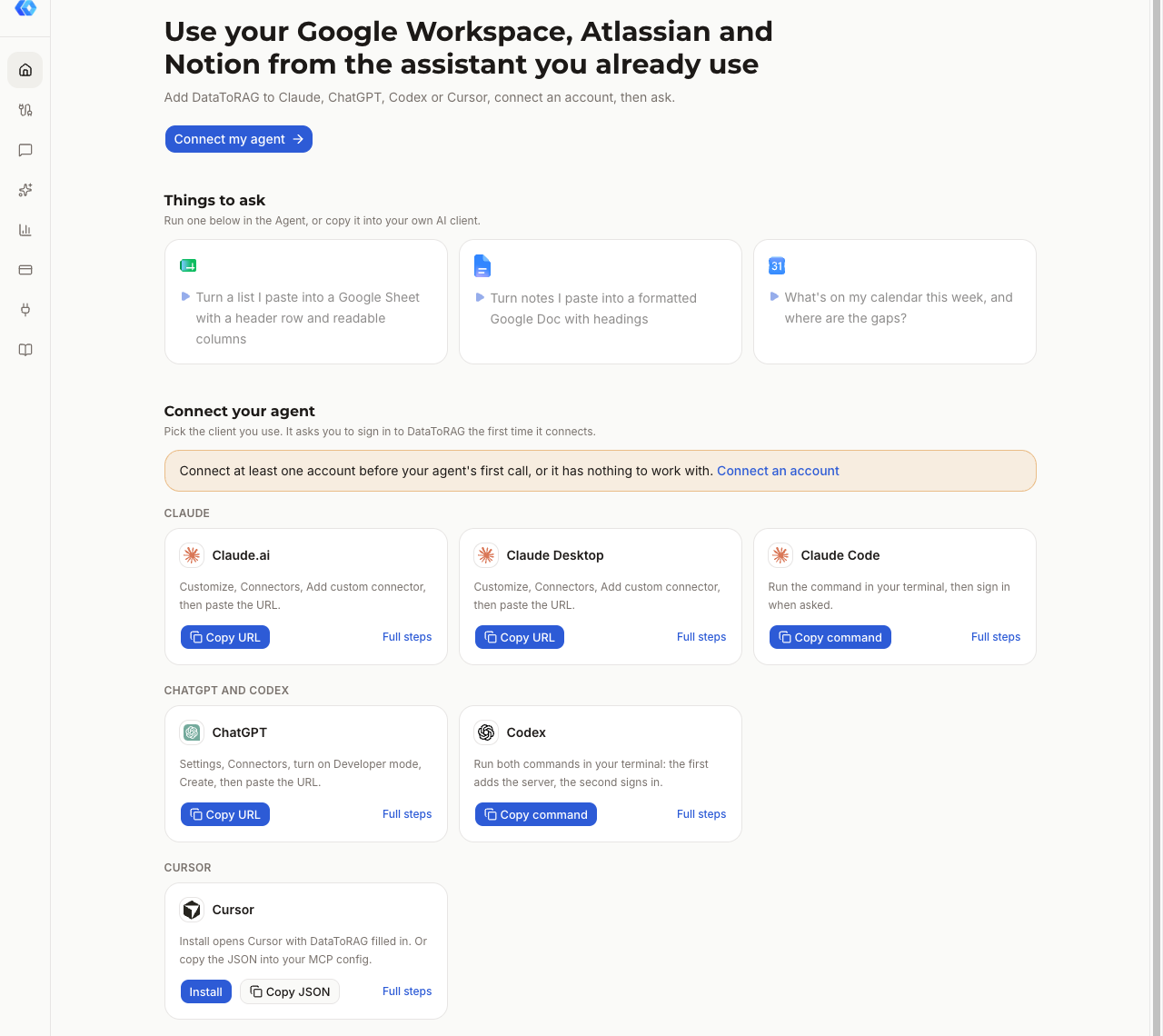
The dashboard home changed in the same release. It used to open on your connected accounts. It now opens on the thing a new account needs first: getting DataToRAG into the assistant you already use. Cards for Claude.ai, Claude Desktop, Claude Code, ChatGPT, Codex and Cursor, each with the exact setup for that client. The server URL with a copy button. The example prompts, tagged with the services they use. One chip per provider showing what is connected. The connection cards moved to their own page.
If you tried DataToRAG before and stopped at the sign-in, the tool list is one request away now, no account needed.
Ready to connect your data to AI?
Give Claude write access to your Google Workspace. Start free, or talk to us about your setup.
Related articles
Before we built anything for write access, we read the threads. People complain about three things: connectors that won't change existing files, OAuth that eats DIY servers, and write access that sounds reckless. Here's each one, sourced, with what we did about it.
You Can Self-Host a Google Workspace MCP for Free. The OAuth Verification Is the Catch.The open-source Google Workspace MCP servers are genuinely good. The cost isn't the code. It's the Google Cloud project, the consent screen, and the verification that comes after.
24-hour re-auth is overDataToRAG MCP now issues OAuth refresh tokens. Your client refreshes silently in the background instead of dragging you back through the Google consent screen every day.