
Blog
Insights on making your data AI-ready.
We Stopped Building and Deploying on the Production Box
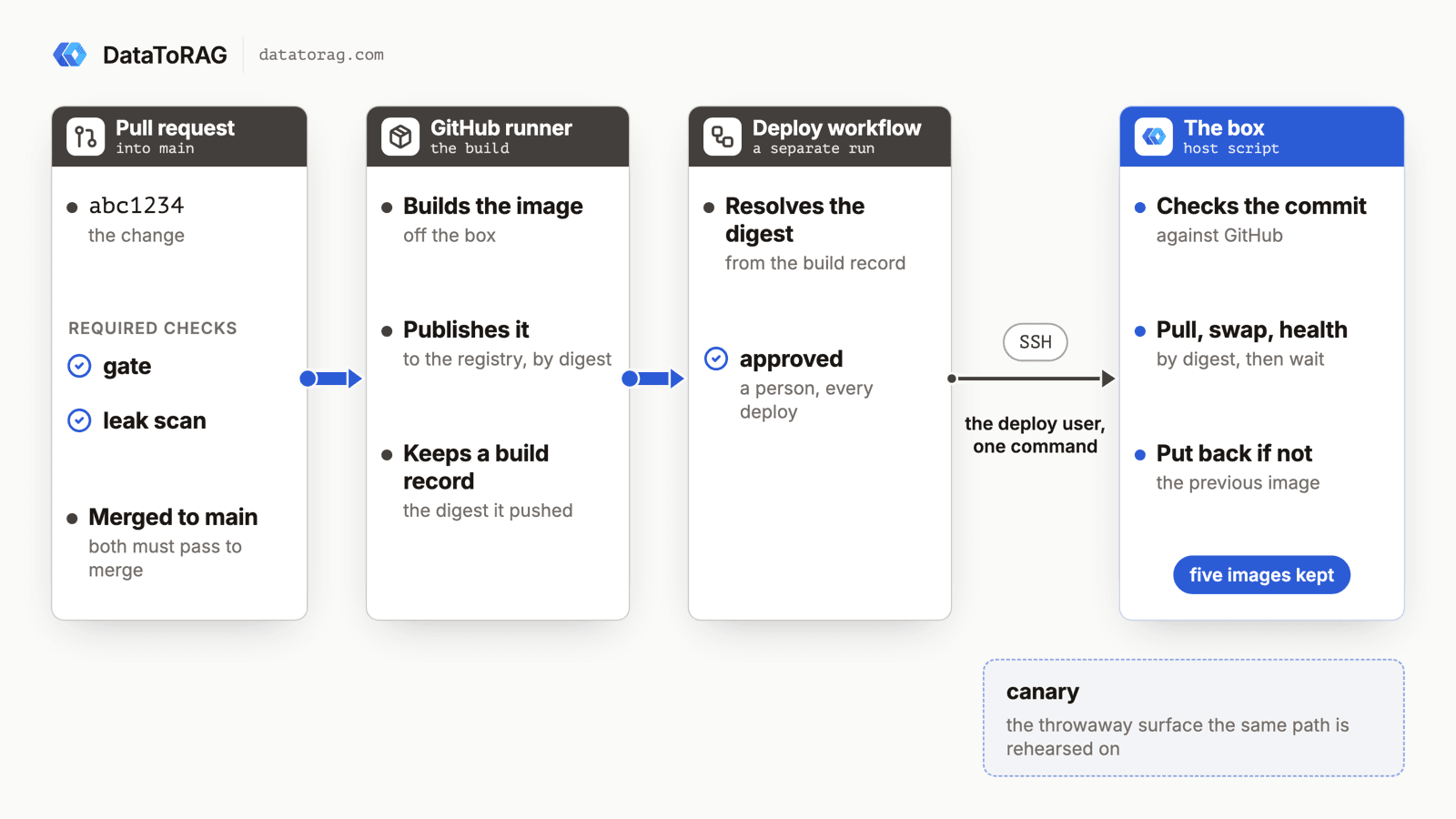
Since the start, the server that runs DataToRAG also built every release of DataToRAG, from a git checkout sitting next to the secrets. Now GitHub builds the image, a person approves the deploy, and the box can do exactly one thing when asked: pull a named image and swap it in. Here is what we built, what we found on the way, and what we decided not to build.
Claude Can File an Email on a Jira Issue Now, Without the Email Going Through Claude
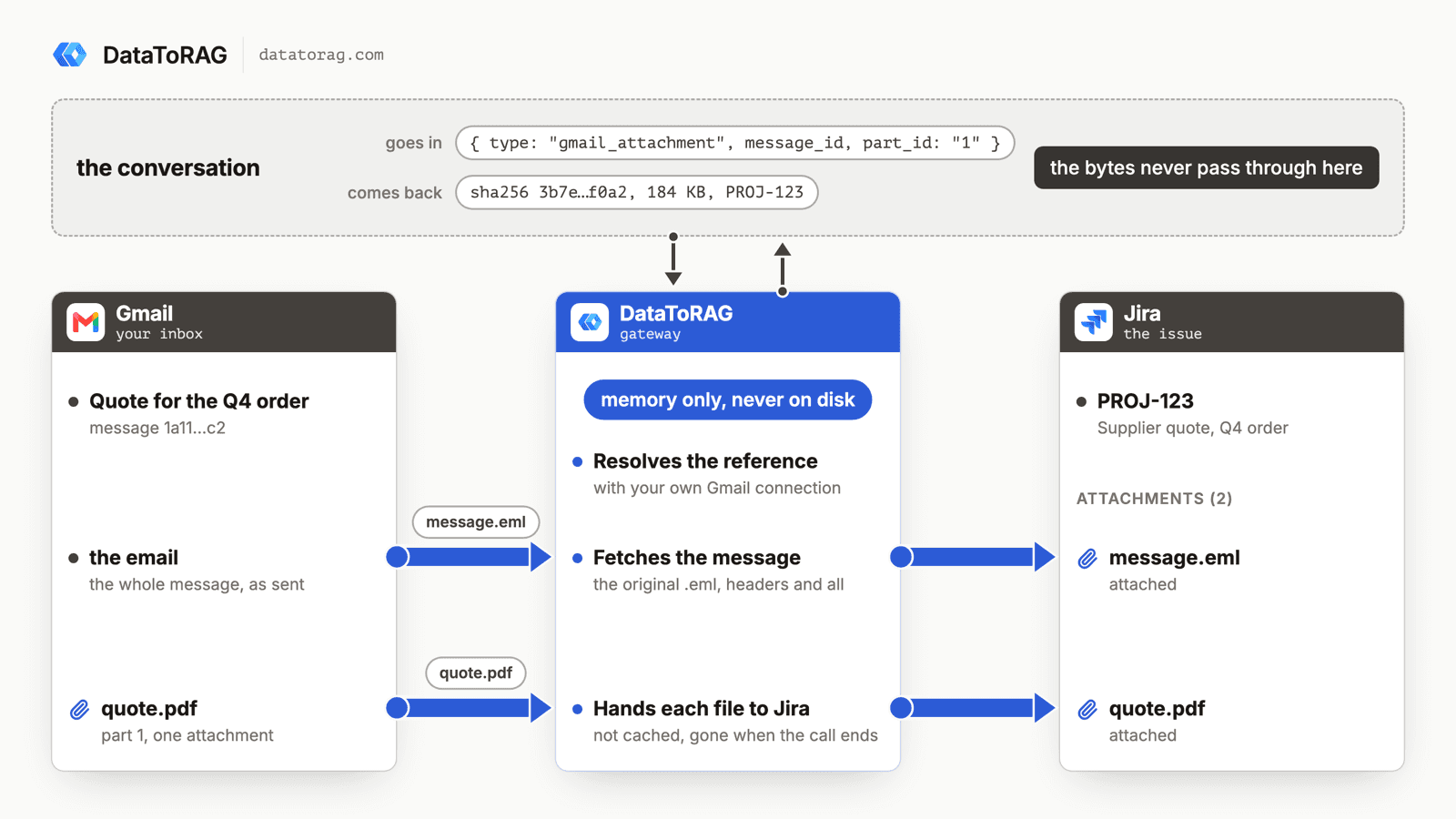
One customer needed every email on a Jira issue as the original .eml, for compliance. He was doing it by driving Chrome. Now it is one tool call, the file goes from Gmail to Jira without touching the conversation, and the answer is a receipt with a hash. The design underneath is a file reference, and it is the shape every cross-service tool we build from here will take.
Your Agent Can Attach Files to Email Now. The Interesting Part Is Where the Bytes Never Go.
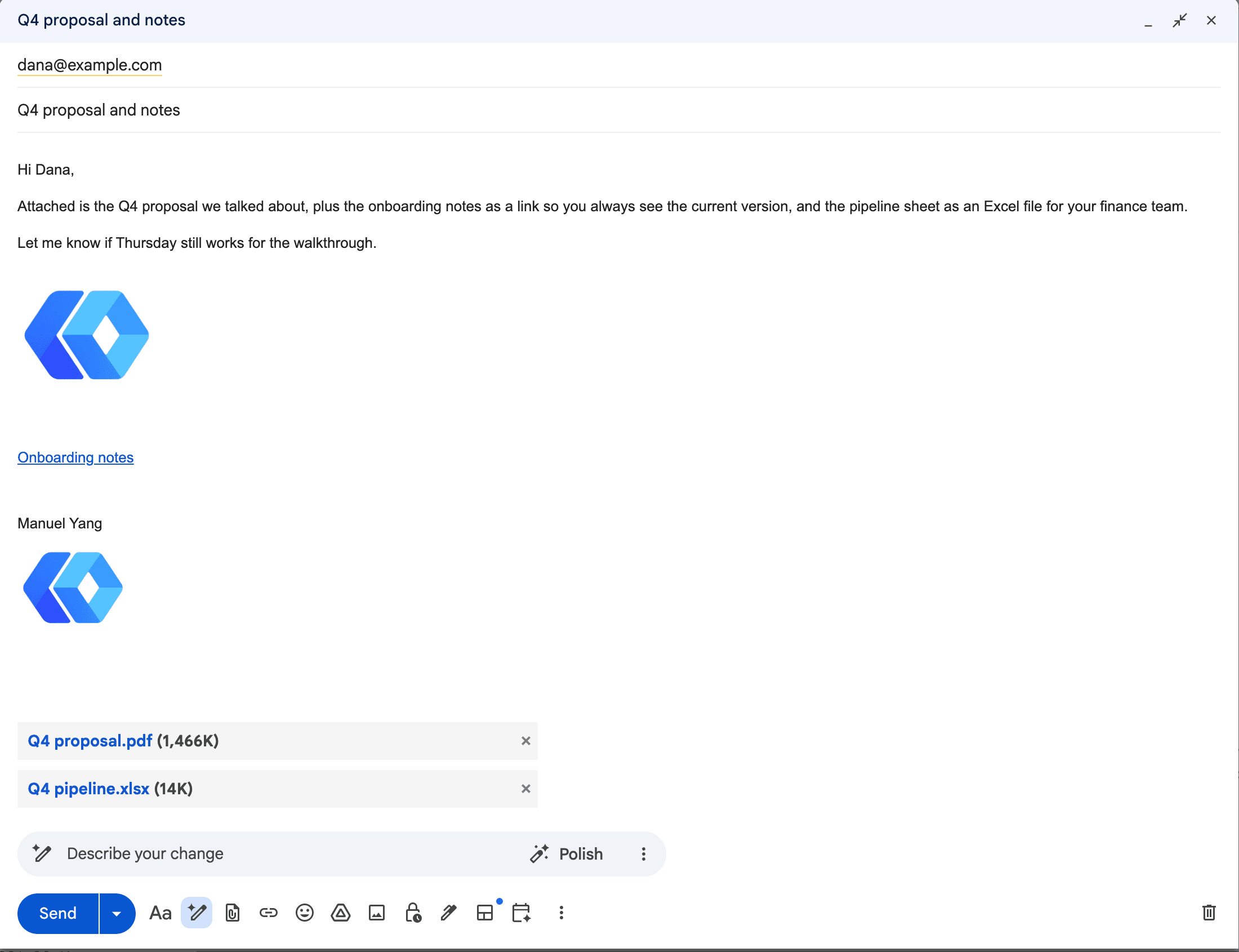
Gmail send, reply, forward and drafts take attachments from Drive: real files attached, Google Docs linked the way Gmail does it or exported as PDF and Word, images inline. The design question underneath is one the MCP spec itself hasn't settled yet, and we picked a side.
How a File Should Move Through an MCP Server (and Why Ours Never Sees the Bytes)
We designed Gmail attachments three ways and built one. What we learned about base64 and tokens, what Claude actually hands a tool when you drop a PDF into the chat, and where the MCP spec is heading, is worth more than the feature.

Skills Are Live: The Routines I Kept Rebuilding by Hand, Now One Click
Eleven published routines for Gmail, Calendar, Drive, Docs, Sheets and Jira. Copy one into Claude or press Run in the dashboard. Here is what the morning brief does, what it cost us to make it finish, and why it never asks you a question.
We Published Our Inbox Triage Routine. Then It Quietly Stopped Running.
The scheduled job missed three of the next ten days and every check passed. Firing and noticing are different jobs, and a check you write cannot verify a run that never happened.
The Model Didn't Hallucinate. Our Tool Description Was Missing.
We read the failed calls on a real account and found something uncomfortable: most of them were not the model getting it wrong. They were our tool descriptions failing to say what the tool could do, and in one case failing to offer something it should have offered.
The Spreadsheet Was Correct. Nobody Could Read It.
Writing values into Google Sheets gives you no formatting at all, and the failure is invisible to whoever caused it. Four new tools fix that: a one-call readable pass, targeted styling, a raw escape hatch, and row lookup that doesn't read the whole sheet.
Claude Can Send Formatted Email Now. Here's What That Took.
Until August 26, our Gmail tools sent every message as plain text, so asking Claude for a formatted email got you literal HTML tags in your inbox. Here's the fix, the one asymmetry to know about, and where the workflow builders stand.
How to Stop Reading Your Inbox
Our inbox-triage skill sorts unread mail across every account you connect, labels and clears the noise, and mails you one digest. The four decisions that make it work, and the prompt-injection hole we caught before shipping the page.
Hosted Google Workspace MCP: DataToRAG vs Google's Official Servers vs Claude's Native Connectors
Google shipped eight official Workspace MCP servers. Claude has three native connectors. We host one endpoint. Every tool on all three, enumerated on August 24, 2026, including the surprise: Google's own Gmail MCP cannot send email.
Your Agent Should Ask For What It Needs
An agent with nothing connected can still answer you. It just can't do anything. We shipped the fix: it notices what's missing, asks for it in the conversation, and finishes the job once you connect.
Reading a Spreadsheet Is Not Reading Data
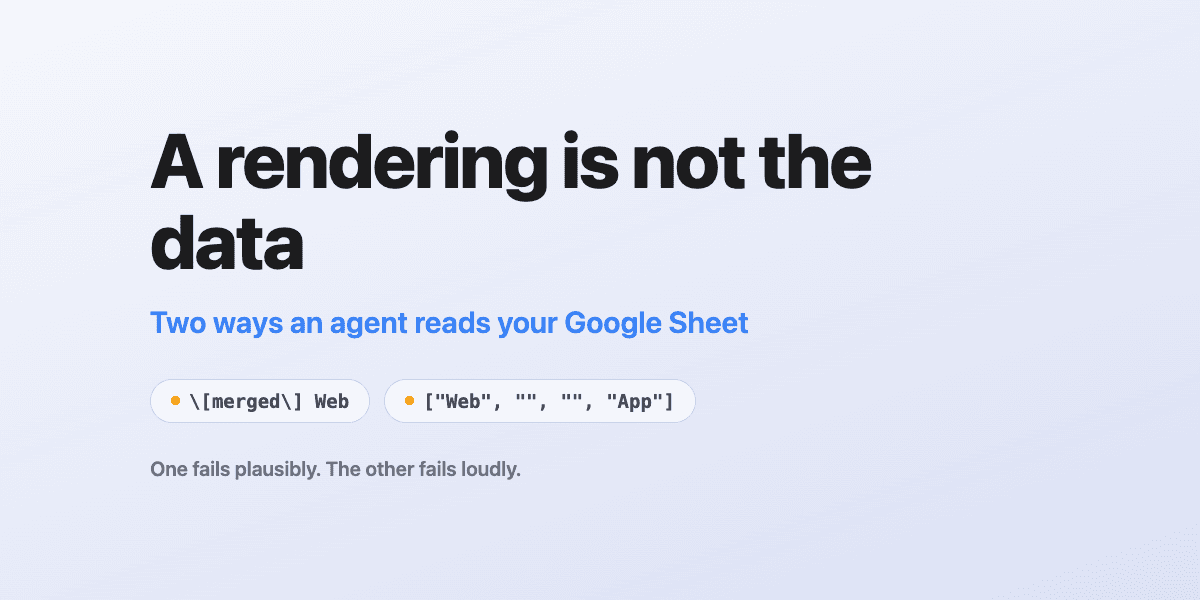
An agent can read a rendering of your spreadsheet or it can read the cells. They look identical right up until they disagree, and you won't be watching when they do.
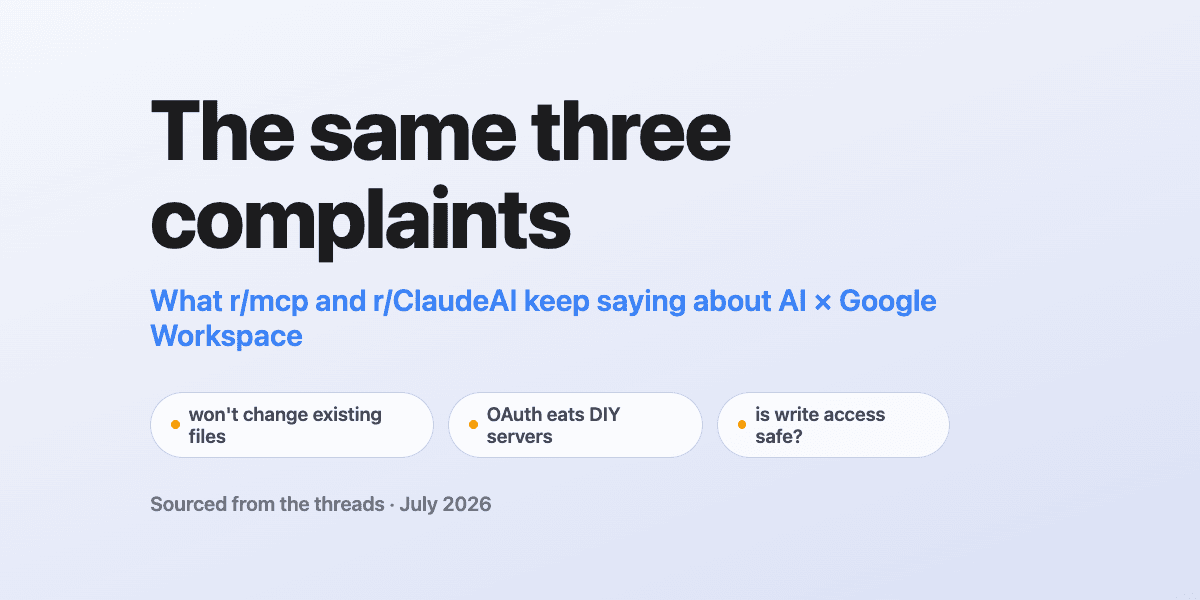
The Same Three Complaints Keep Showing Up in MCP Threads on Reddit
Before we built anything for write access, we read the threads. People complain about three things: connectors that won't change existing files, OAuth that eats DIY servers, and write access that sounds reckless. Here's each one, sourced, with what we did about it.
Composio vs Pipedream Connect: Same Pitch, Different Plumbing
Both sell developers a way to wire their users' apps into an agent product. Composio leans on per-user MCP URLs, Pipedream on external user IDs and Connect Links. Here's how they differ, and the question to ask before you pick either.
Composio vs Zapier MCP: Two Different Bets (and the Question Neither Answers)
Composio is integration infrastructure for developers shipping agents. Zapier MCP is automation breadth for people who already live in Zaps. If the actual question is 'how do I get Claude working deep in my Google Workspace', both answers come up short.
Looking for an Open-Source Composio Alternative? Check Which Part Is Actually Open.
Composio's SDKs are open source. The runtime that holds your tokens and executes your calls is not, and self-hosting it is an enterprise-plan conversation. If 'open source' means 'I can run the whole thing myself', the license on the SDK isn't the license that matters.
Your assistant can now run your Gmail drafts end to end
Two new tools complete the draft lifecycle, and Gmail reads got a compact mode that cuts a typical email to 2% of its former size.
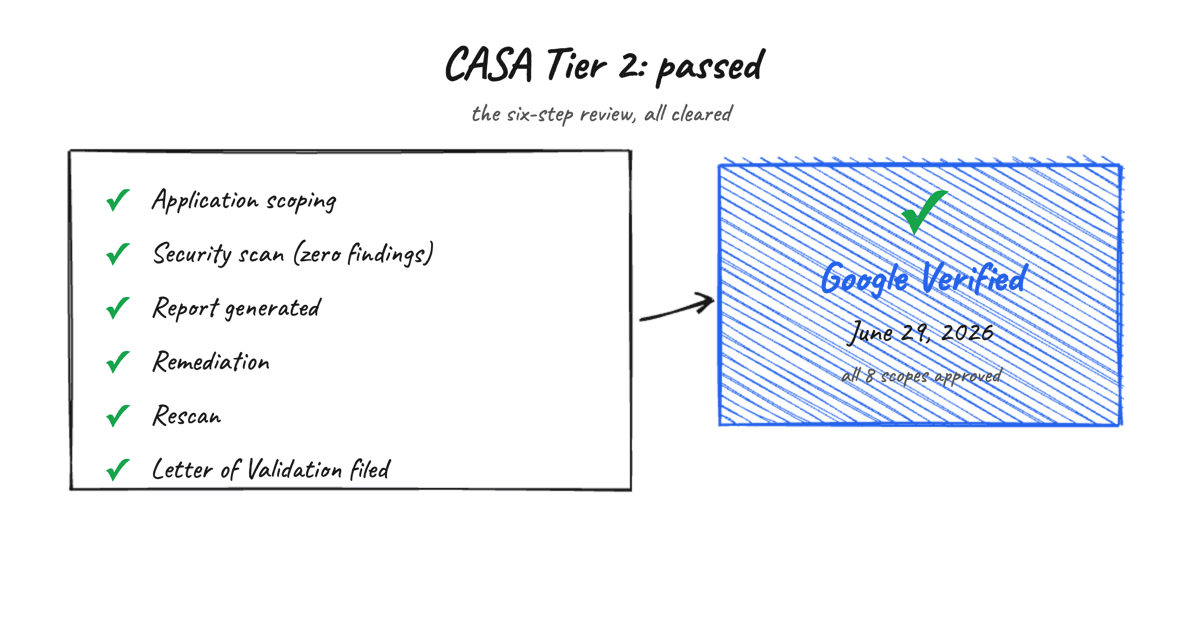
We passed: DataToRAG is now a Google-verified app
Google approved our verification on June 29, 2026. The 'unverified app' warning is gone. Here's how the CASA Tier 2 review actually went, and what changes for you.
Every Way to Connect Claude to Your Google Workspace, Compared (2026)
Native connectors, Zapier MCP, Composio, Pipedream, a self-hosted open-source server, or DataToRAG. What each one really does with your Google data, and how to pick the right one.
Composio Is for the Developer Shipping an Agent. DataToRAG Is for You.
Composio is a strong platform for developers wiring tools into agent products. If you just want Claude working in your own Google account, you'd have to write code to get there. DataToRAG is the part you sign into.
You Can Self-Host a Google Workspace MCP for Free. The OAuth Verification Is the Catch.
The open-source Google Workspace MCP servers are genuinely good. The cost isn't the code. It's the Google Cloud project, the consent screen, and the verification that comes after.
Pipedream Wants You to Build the Integration. DataToRAG Is the Integration.
Pipedream Connect is excellent infrastructure for embedding tool access into your own product. But if you just want Claude to use your Google Workspace, you'd be building a product to do it. DataToRAG is the one you sign into.
Zapier MCP Connects 9,000 Apps. We Went Deep on Google Workspace Instead.
Zapier MCP is the widest way to hand Claude tools. Its Google Workspace actions stay shallow, though. Here's the tradeoff, and where a focused gateway wins.
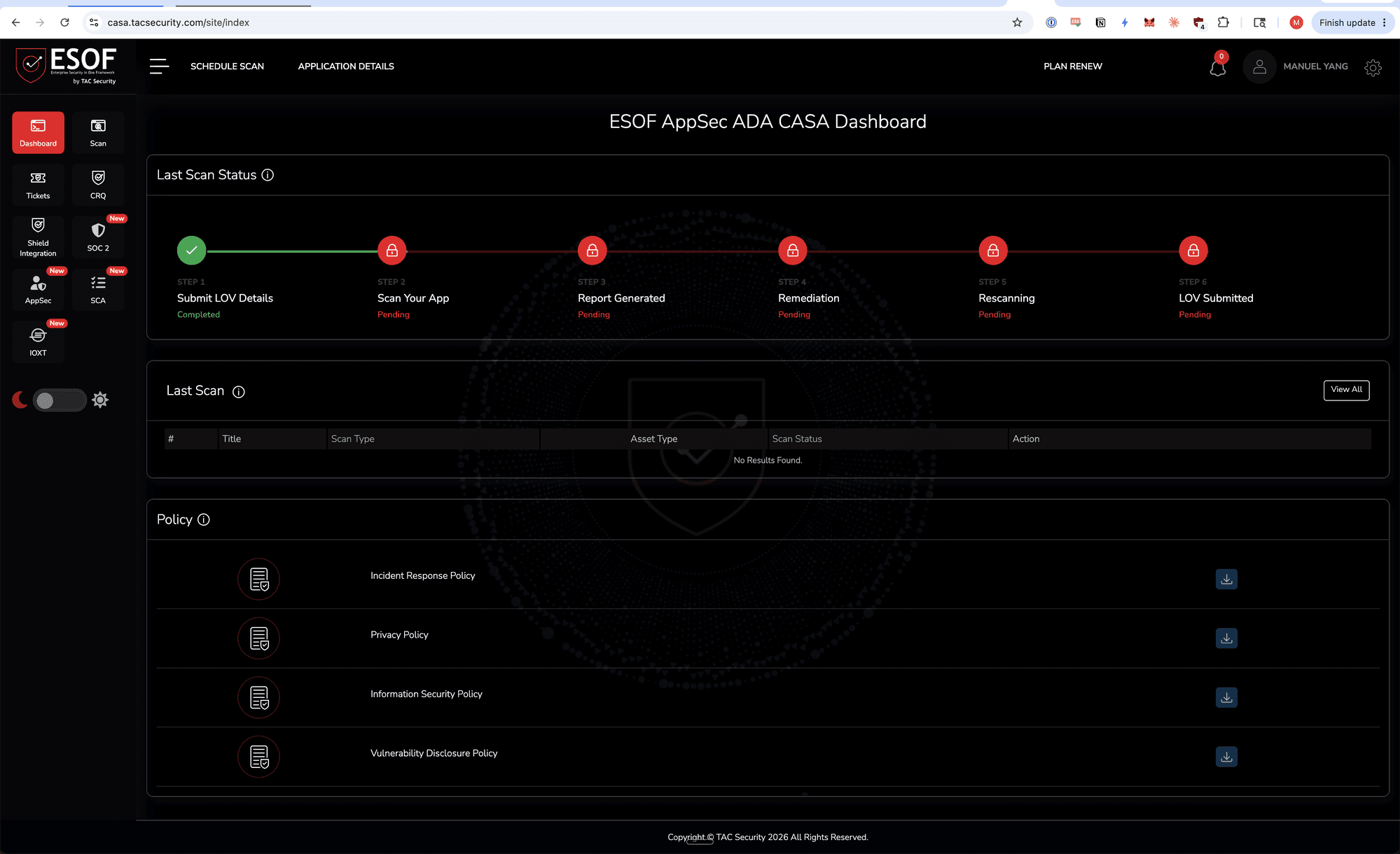
CASA Tier 2 update: step 1 of 6 cleared, lab scan starts next
A progress note from May 2026, partway through Google's CASA Tier 2 review: application scoping cleared, lab scan next. The review has since completed and DataToRAG is verified.
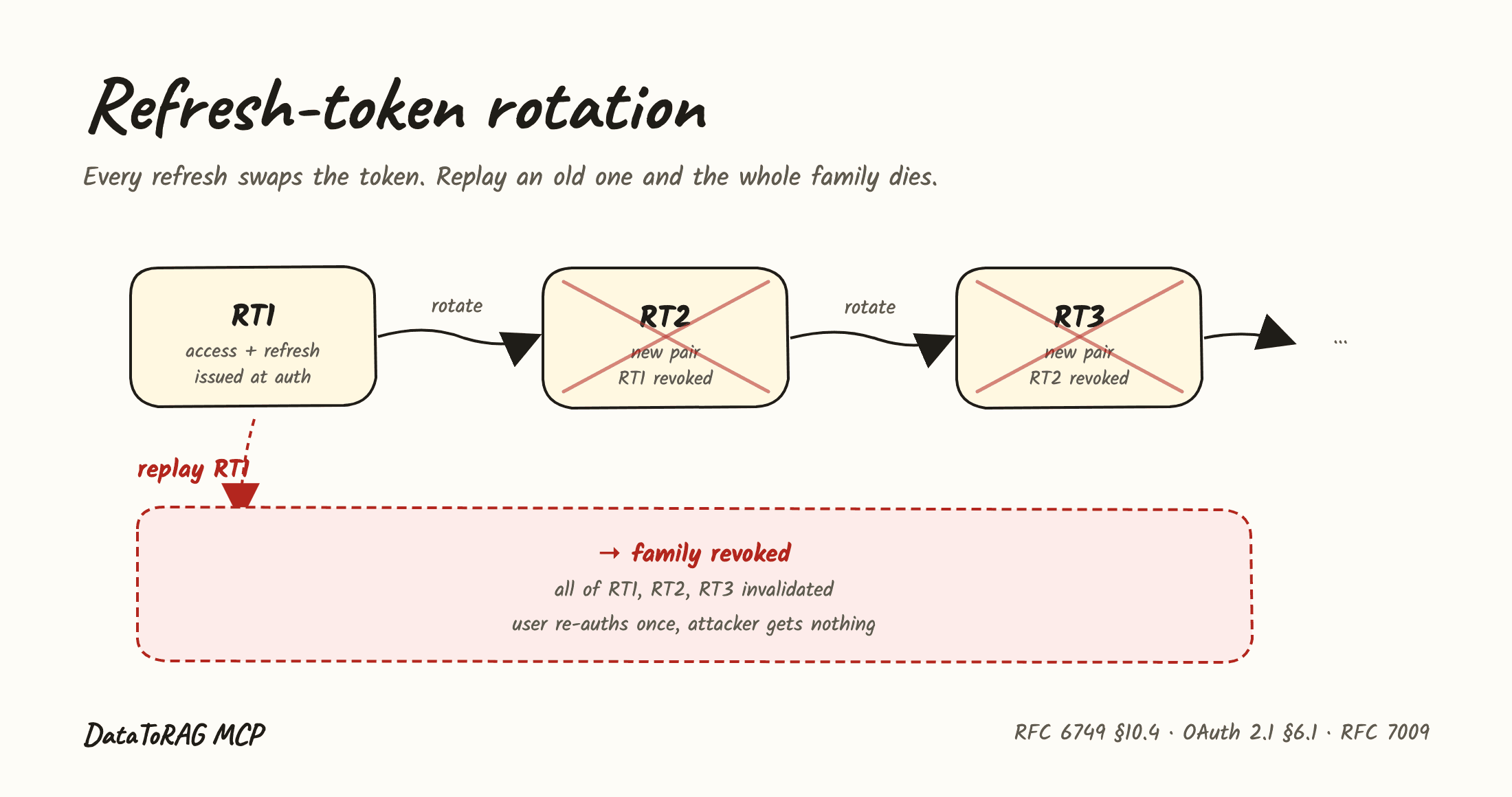
24-hour re-auth is over
DataToRAG MCP now issues OAuth refresh tokens. Your client refreshes silently in the background instead of dragging you back through the Google consent screen every day.
The 'unverified app' warning, explained: where we are with Google's CASA review
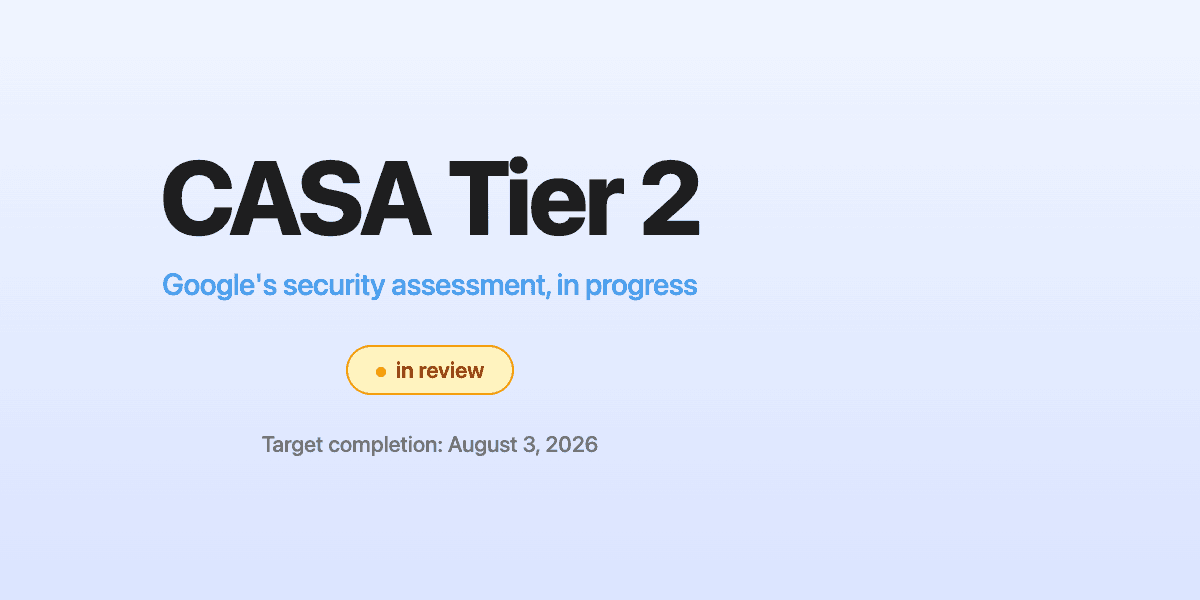
DataToRAG is going through Google's CASA Tier 2 security assessment. Until it's done, you'll see Google's 'unverified app' warning when connecting your Workspace. Here's what's happening and why you can click through it.
We Said Claude Couldn't Send Email. It Can Now.
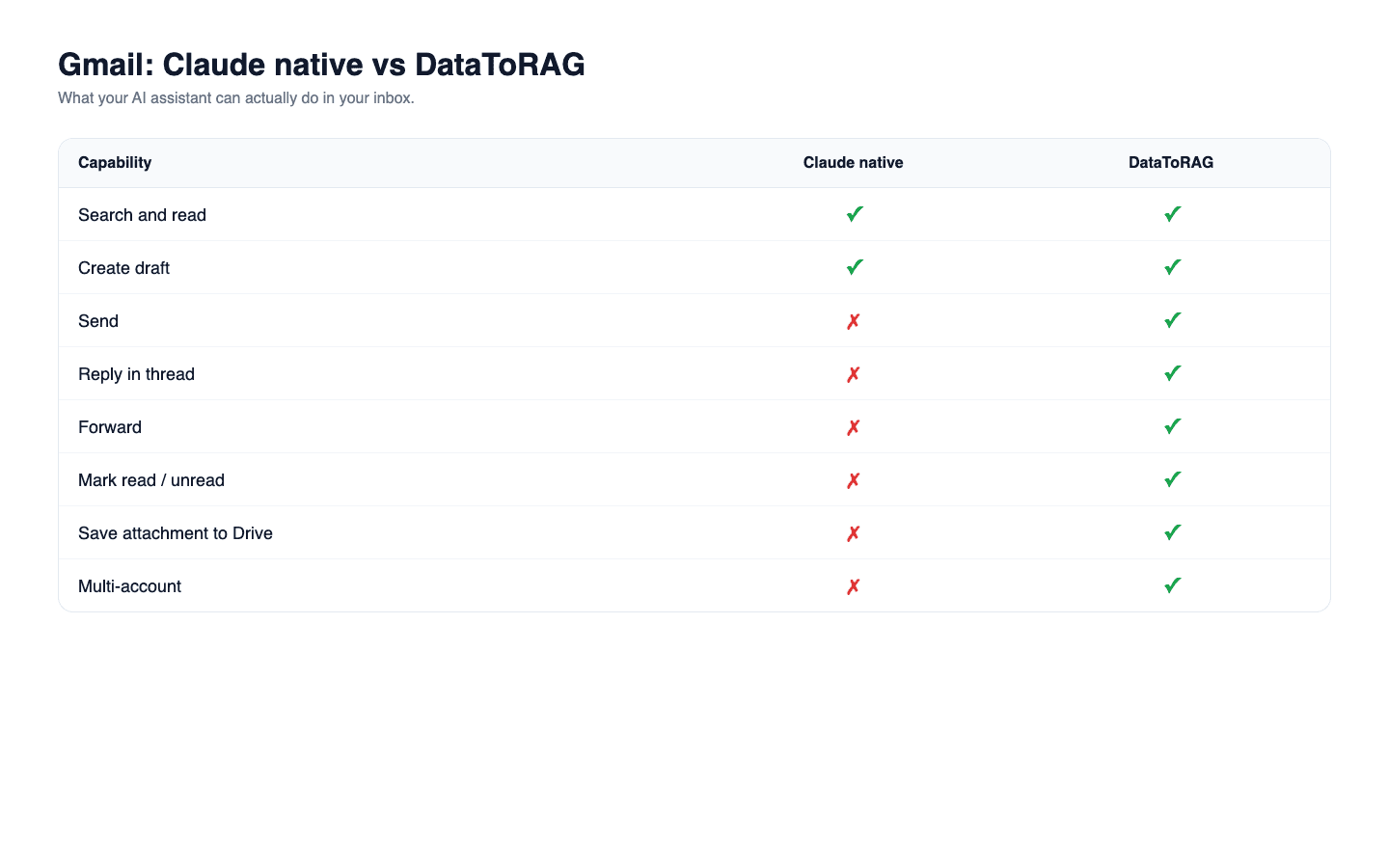
This post used to argue that Claude's native Gmail connector drafts but never sends. As of August 24, 2026 that is wrong: it sends, replies, and forwards. Here is the corrected comparison, and the two rows that are still ours.
Claude's Calendar Connector Works. Unless You Have Two Calendars.
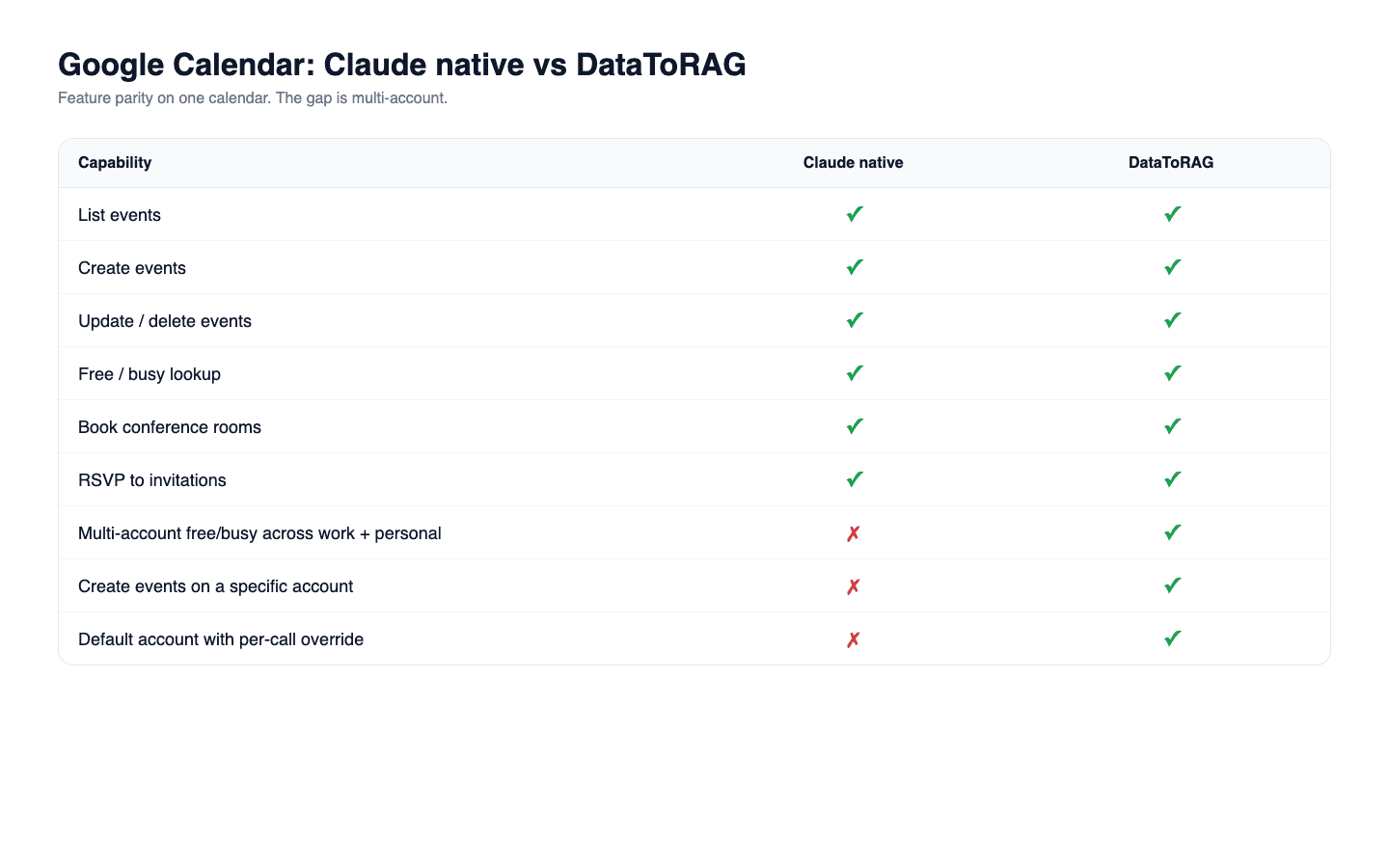
On a single account, Claude's native Calendar connector does more than ours: it searches events, suggests times, and RSVPs. What it can't do is see two calendars at once.
Claude Can Read Your Google Docs. It Can't Edit Them.
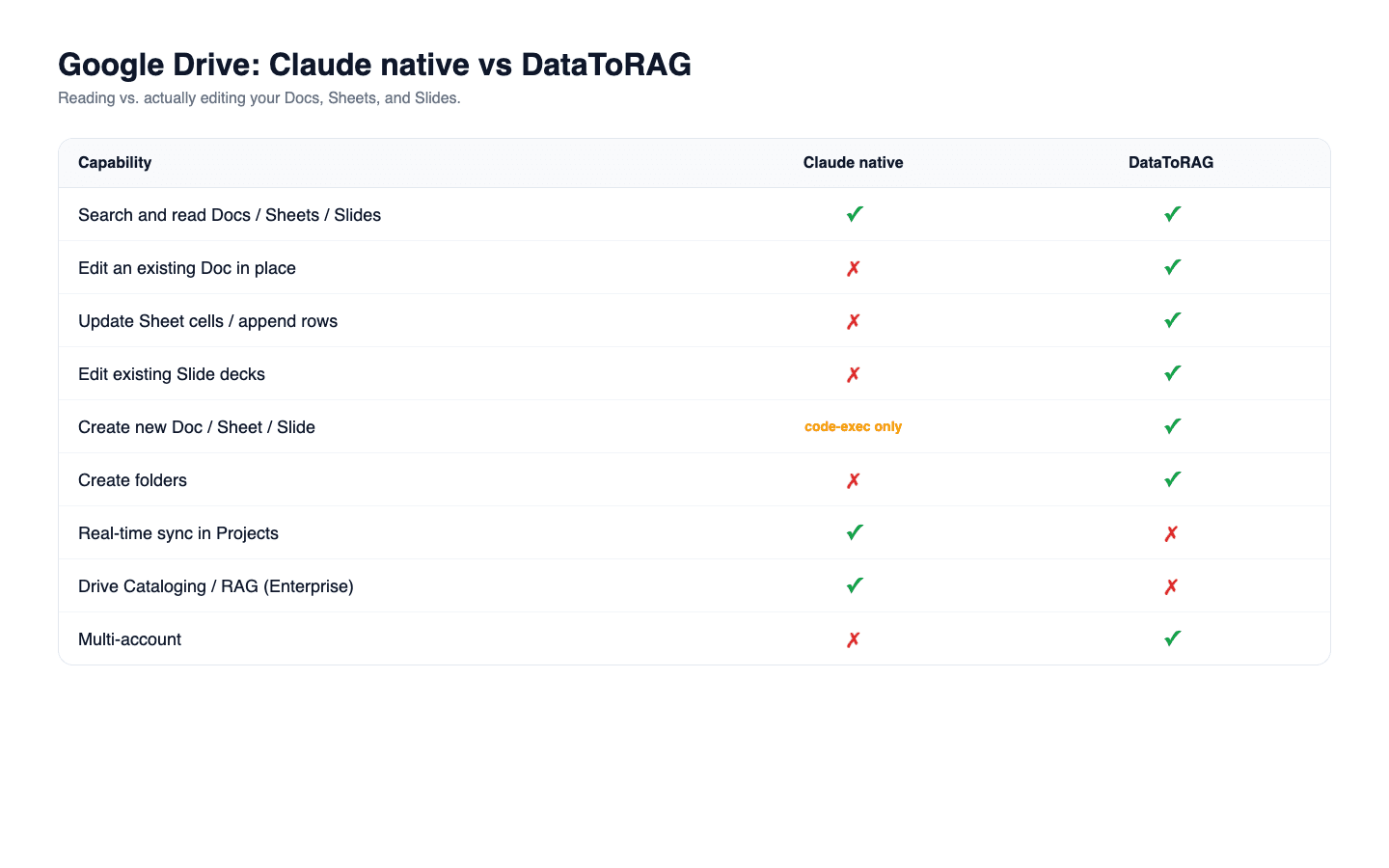
Claude's native Google Drive connector reads your files and creates new ones, but it can't change what is inside a file you already have. DataToRAG lets Claude write Docs, update Sheets, and edit Slides in place.
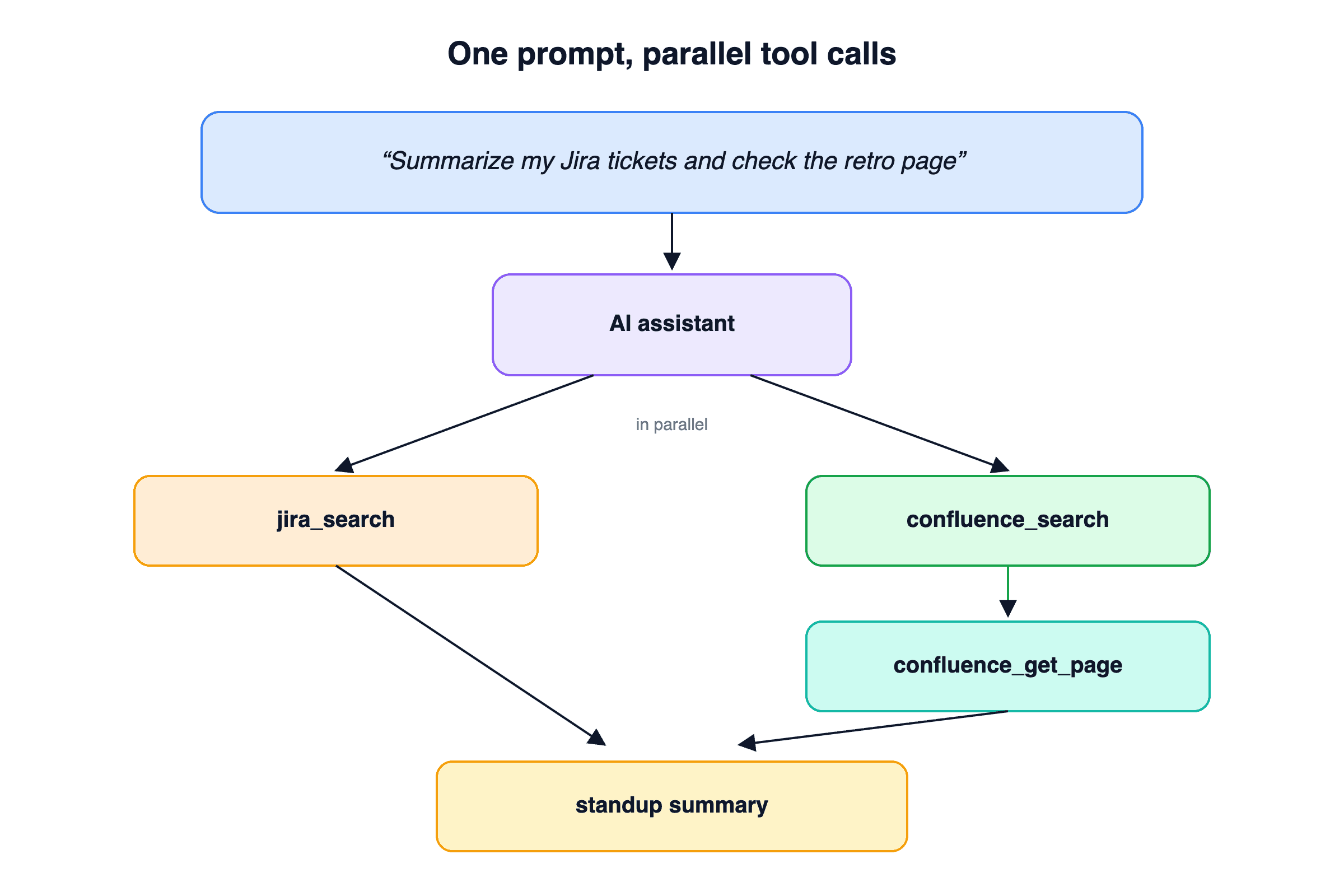
One Prompt, Jira and Confluence Both Move
The Atlassian connector isn't two separate integrations. It's the cross-product workflow that always lived in a Google Doc.
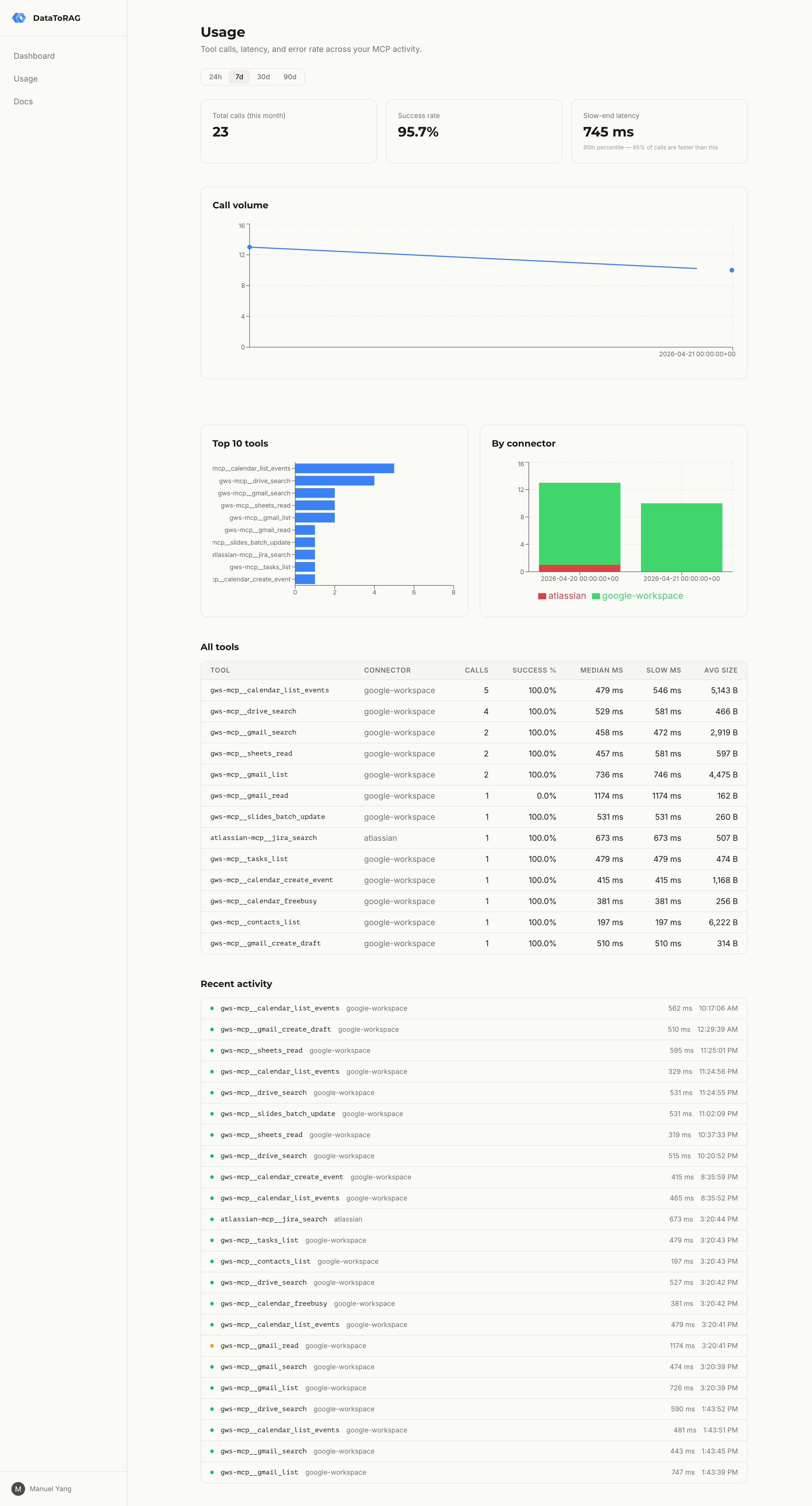
Building a Usage Dashboard Without Logging User Data
How we show users exactly what their AI assistant is doing (calls, latency, errors) without storing a single argument or response body.
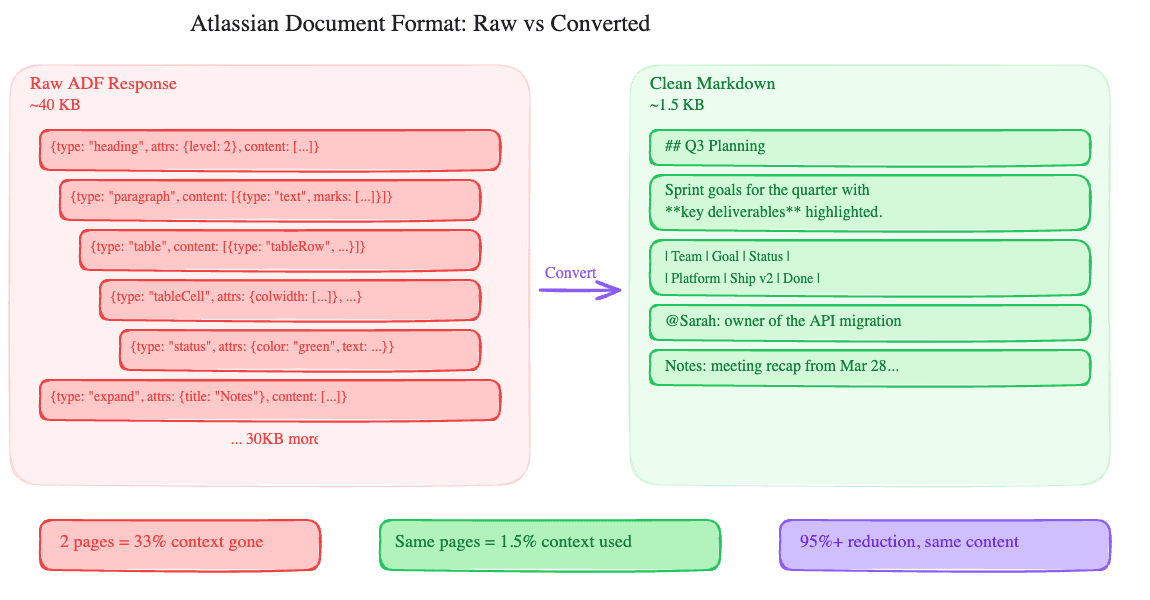
Confluence Pages Are 40KB of Markup. Your AI Gets 2KB.
Confluence storage format is verbose XML that destroys context windows. We convert it to clean text by default, with a format switch for when you need the raw markup back.
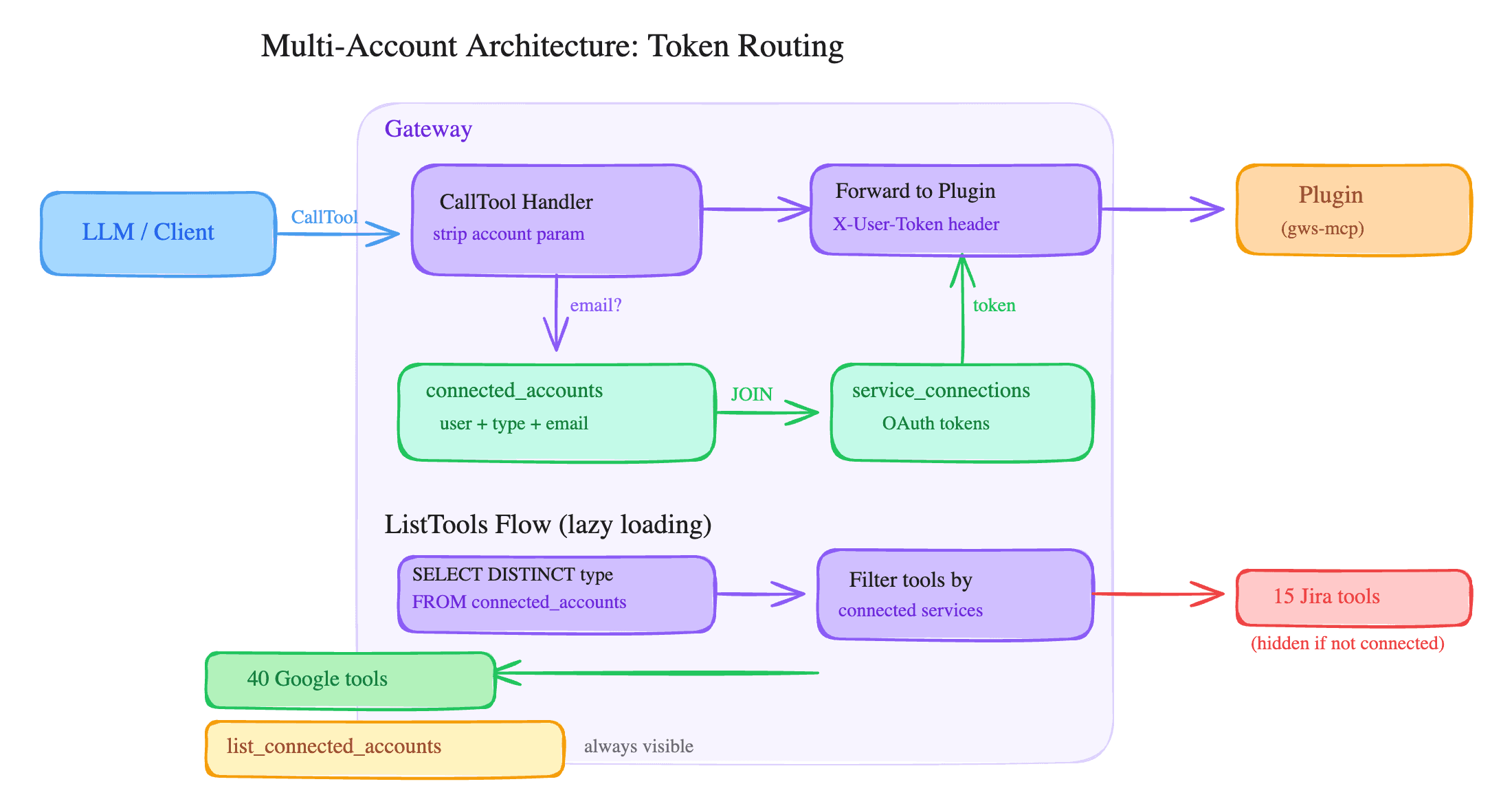
How We Built Multi-Account for MCP
The database changes, token routing, and tool schema tricks behind supporting multiple Google accounts in a single MCP server.
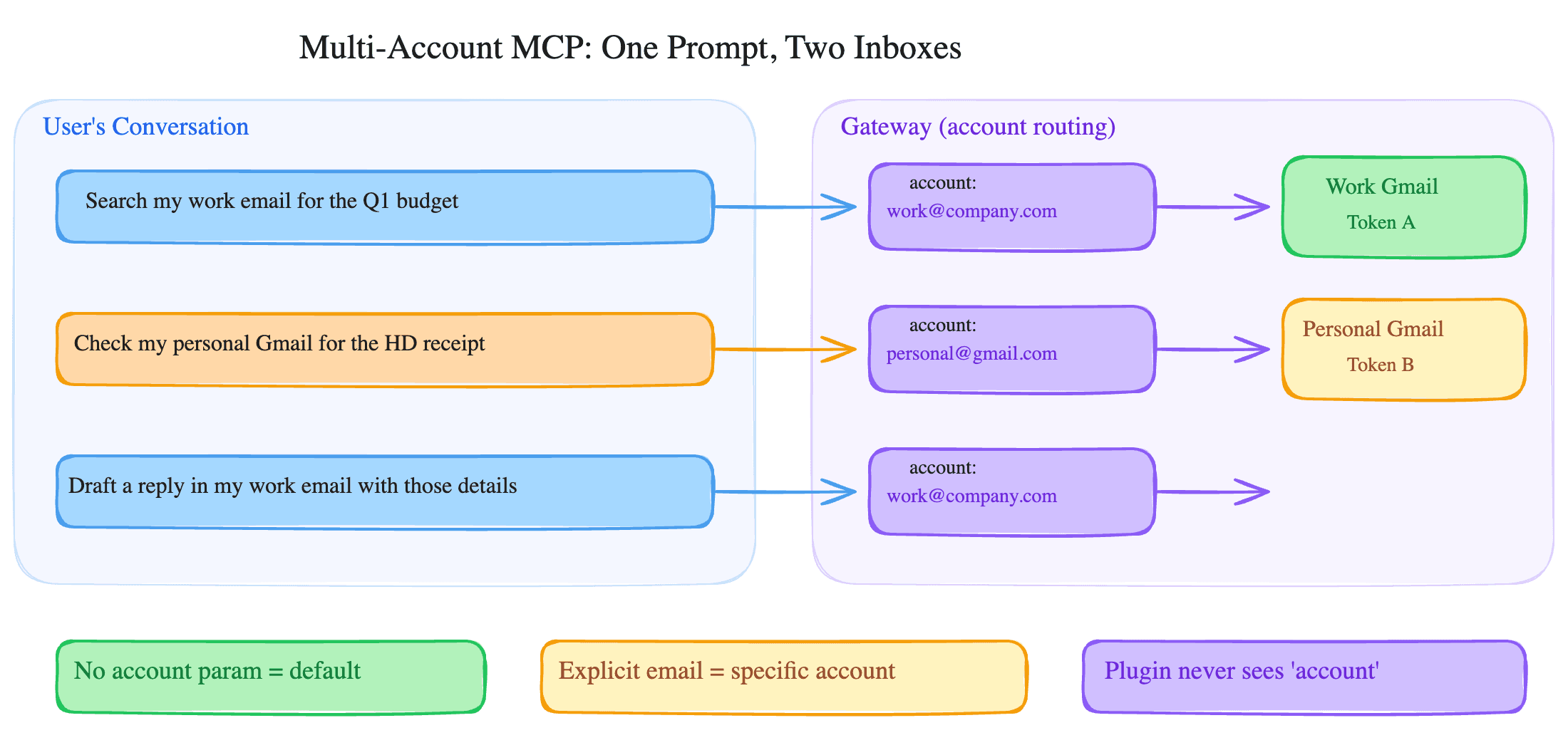
One Prompt, Two Inboxes: Multi-Account Support for MCP
Most MCP servers assume one user means one account. We built multi-account support so you can query your work and personal Google accounts in the same conversation.
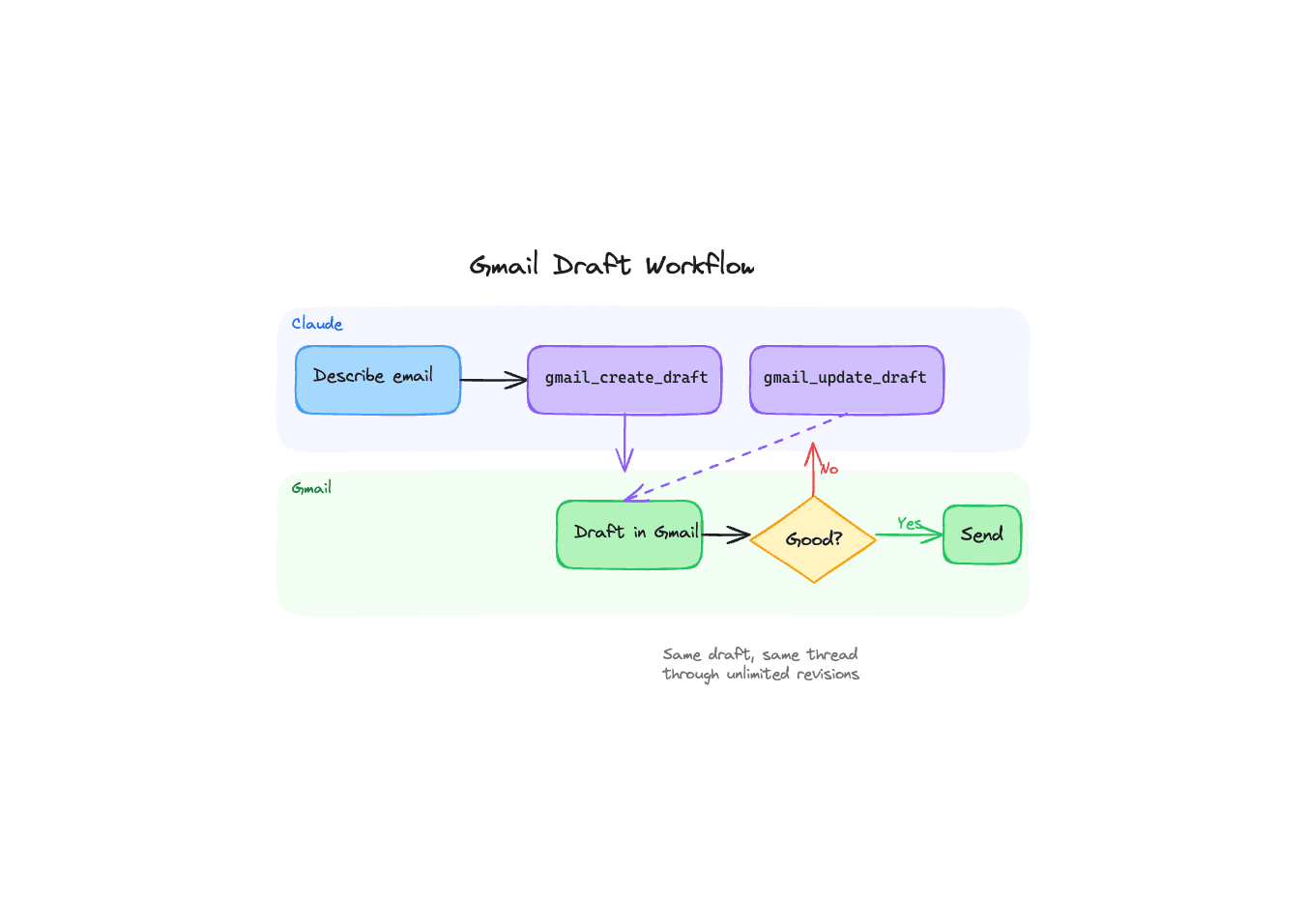
AI-Powered Email Workflows with the Gmail Draft Tool
Most AI email tools generate and send in one shot. We built a draft workflow instead, because anything that matters deserves a second look before it leaves your outbox.
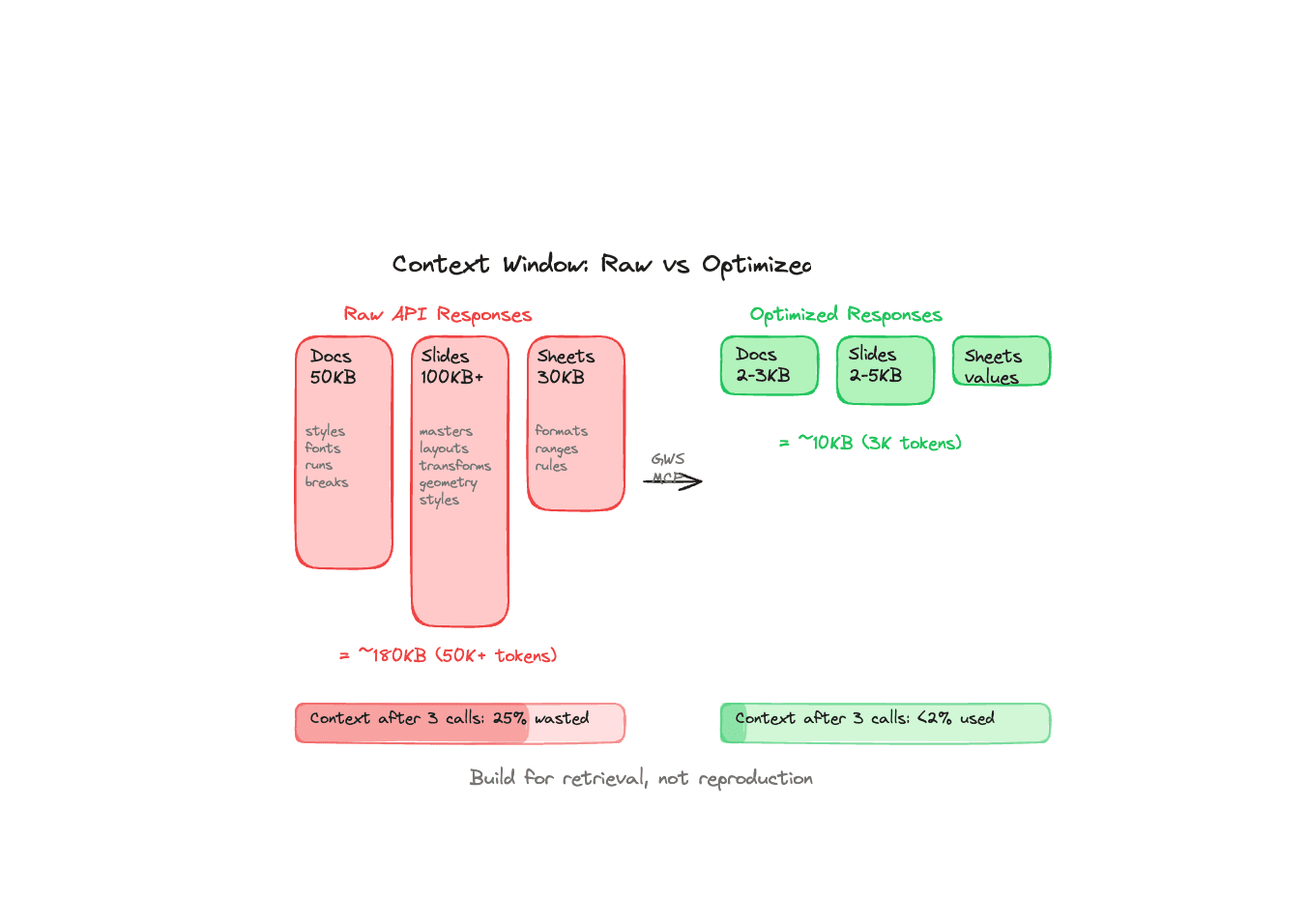
Why Your MCP Server Is Eating Your Context Window
A Google Doc produces 50KB of JSON through the API. Your AI assistant doesn't need 98% of it. Most MCP servers send it all anyway.
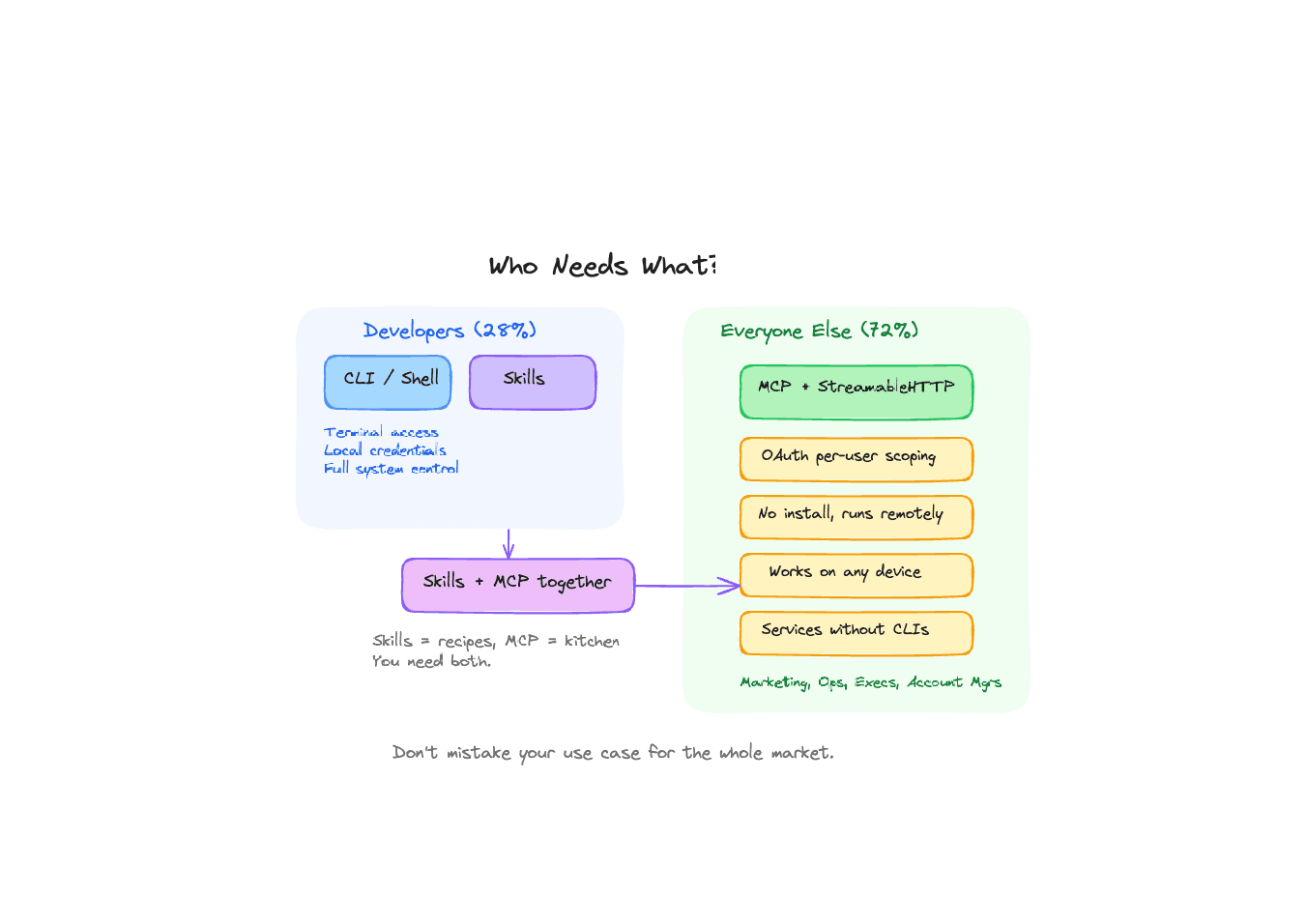
MCP Isn't Dead. You're Just Building for Yourself.
The 'just use CLIs' crowd has a point. But it only holds if every user of your tool is a developer with a terminal open.
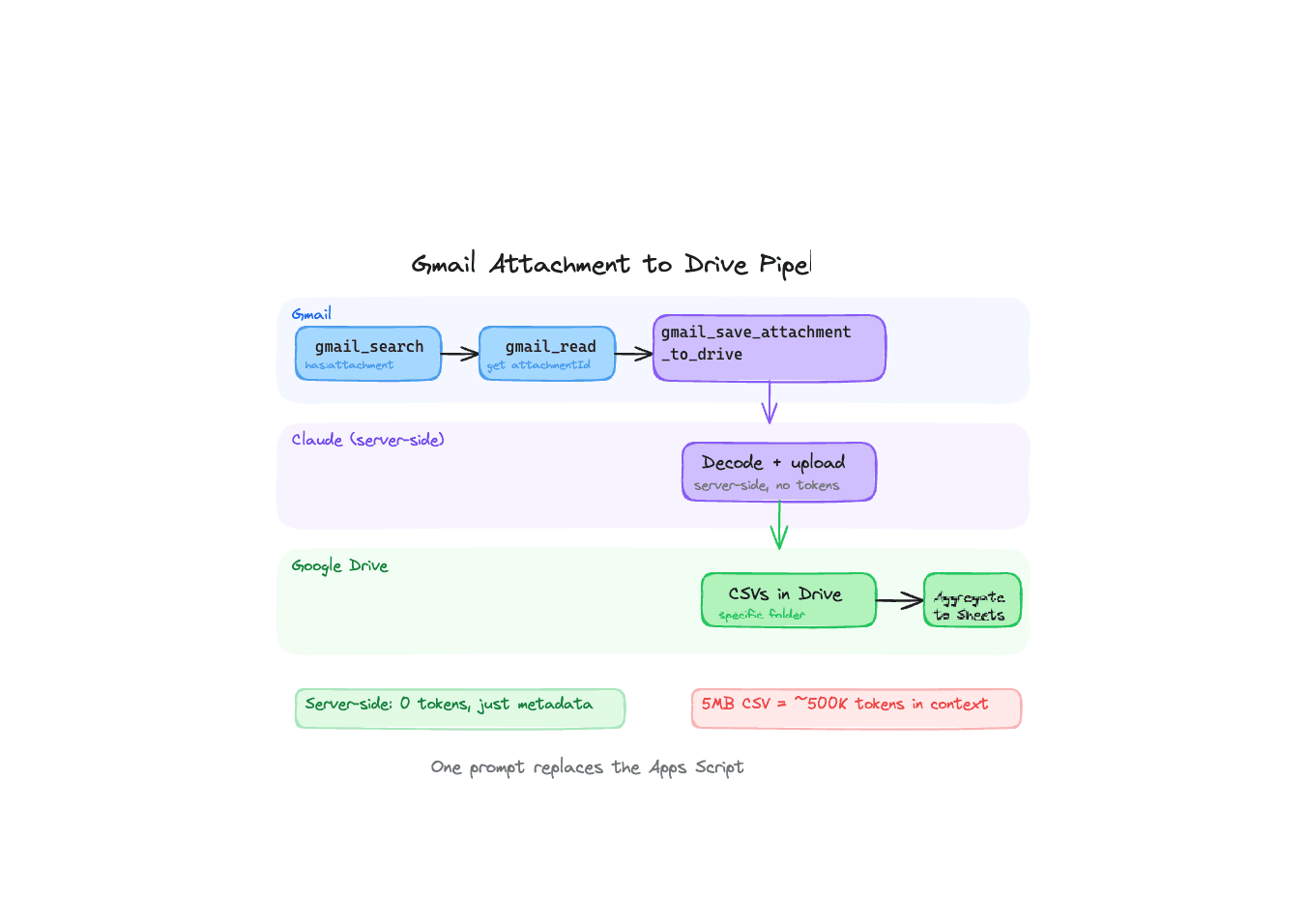
Save Gmail Attachments to Drive with Claude
A team was running an Apps Script to save 6 daily report emails to Drive. We replaced it with one prompt.