
The Gaps in the Comparison Table Were Ours. They Are Closed.
The comparison table on our home page is the first thing a visitor sees now. It lists what Claude's own Gmail, Calendar, Drive and Atlassian connectors do, next to what ours does, one row per capability. When I moved it into the hero last week, ten rows read Yes for them and No for us. That is a bad thing to lead with, so I closed them.
What changed on October 19
On the Google side, ten tools; on the Atlassian side, four Jira tools, two Confluence tools widened, and Drive files as file references. All live, all in the registry, with tests that run against production.
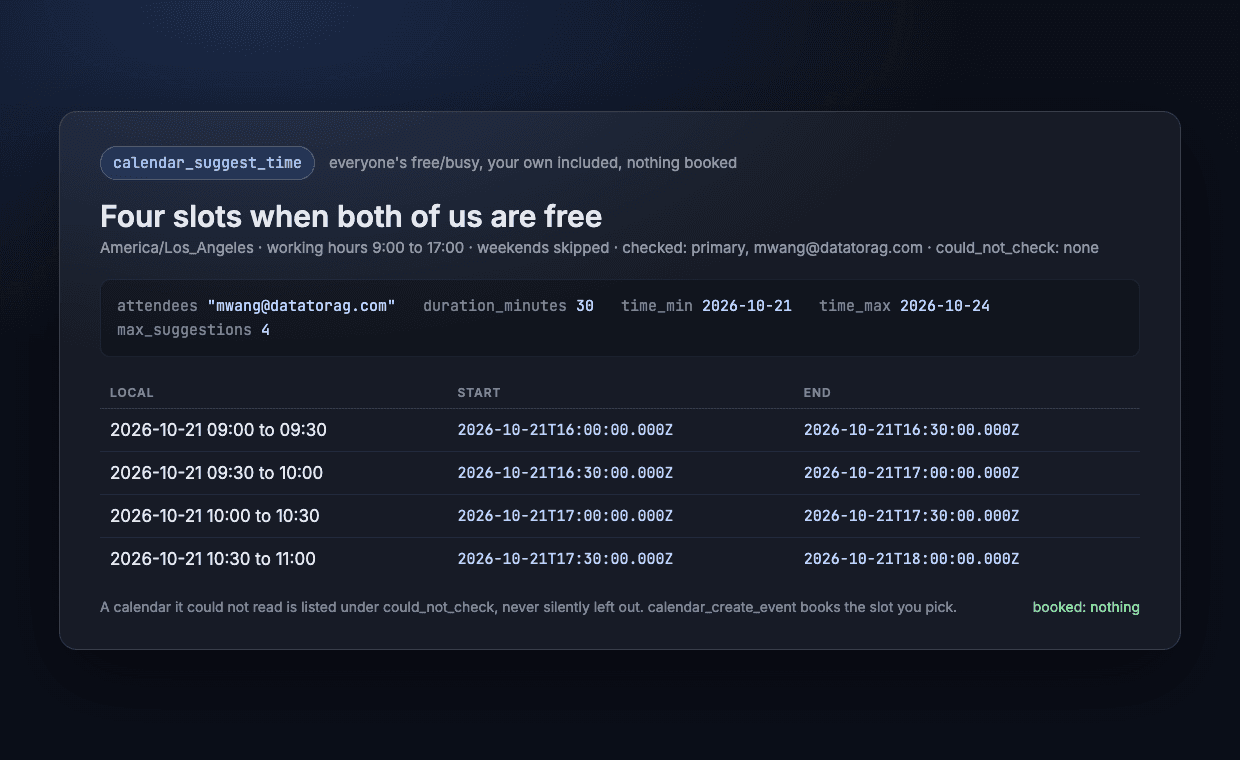
Calendar. calendar_respond_to_event answers an invitation as accepted, declined or tentative, and changes only your own response. calendar_suggest_time takes the people you name, a duration and a range, reads everyone's free/busy including your own, and returns slots inside working hours, with the people whose calendars it could not read listed separately so a missing answer is never silent. calendar_list_calendars lists the calendars on the account.
Gmail. gmail_label_message takes a thread_id, so a label goes on or comes off a whole conversation in one call. gmail_trash_thread and gmail_untrash_thread do the same for Trash. gmail_mark_spam and gmail_unmark_spam report a message as spam and take it back.
Drive. drive_share_file shares a file or folder with one person as reader, commenter or writer and returns the permission list afterwards. drive_get_file_permissions lists who has access. drive_list_recent_files lists what you opened or changed last.
Jira. jira_add_worklog logs time in Jira's own format, 1h 30m, with a start time and a comment. jira_list_worklogs lists what was logged with the total. jira_link_issues links two issues by the link type's name or its phrase, so "PROJ-1 blocks PROJ-2" is one call. jira_list_issue_links lists an issue's links from its own side, with the link types the site has.
Confluence. confluence_add_comment anchors an inline comment to a piece of the page's text and replies to inline comments as well as footer ones. confluence_get_comments returns each thread with its replies, which comment each one answers, and for an inline comment the text it sits on and whether it is resolved.
Drive files move like email does. A Drive file, or a Google Doc exported as a PDF, is now a file reference. The same reference that moves an email attachment to your computer, onto a Jira issue, or into another account's Drive takes a Drive file too, and the content never enters the conversation.
Why parity and not "tools on demand"
Until last week the rule was that a tool gets built when someone's usage shows they need it. That rule still stands for everything outside the table. For the table it was wrong. A comparison that you put at the top of the page is a promise about what you do, and a row that says No for us is a reason to pick the other connector that I was printing myself.
There is a second reason. The built-in connectors are one account each. Ours take an account on every call, so a person with a work and a personal Google account uses both in one conversation. Someone who switches to us for that should not lose RSVP, spam, sharing or worklogs on the way.
What the table says now
What ours does that the built-in connectors do not: filtered queries on a sheet, two Google accounts in one request, content in a Slides deck rather than an empty one, a free/busy lookup, an email or one of its attachments saved to Drive or to your computer, Google Contacts, Google Tasks, an email attached to a Jira issue, and a work and a personal account at the same time.
What is still theirs: recurring events, rooms, and attachments on a calendar event. Those three are on the list.
The five comparison posts on this blog that made claims the other way carry a dated edit note from October 19 saying which rows flipped. The table on the home page and the posts are checked against the tool code, not against each other.
What this costs you
Nothing in tokens you do not ask for. Every tool in the connector has a short description and a schema that names only the arguments it takes, and the gateway serves over a hundred of them. A tool you never call is a few lines in the list. The full table, with every row and its test, is on the home page.
Ready to connect your data to AI?
Give Claude write access to your Google Workspace. Start free, or talk to us about your setup.
Related articles
Our Google Workspace connector has always had an escape hatch: a tool that sends one raw request to any Google API. We looked at what it was actually being used for. Most of it was the same few jobs, and a third of it was jobs we already had a proper tool for. So nine of those jobs got a tool of their own, and the escape hatch has gone behind a door.
Claude Can File an Email on a Jira Issue Now, Without the Email Going Through ClaudeOne customer needed every email on a Jira issue as the original .eml, for compliance. He was doing it by driving Chrome. Now it is one tool call, the file goes from Gmail to Jira without touching the conversation, and the answer is a receipt with a hash. The design underneath is a file reference, and it is the shape every cross-service tool we build from here will take.
Your Agent Can Attach Files to Email Now. The Interesting Part Is Where the Bytes Never Go.Gmail send, reply, forward and drafts take attachments from Drive: real files attached, Google Docs linked the way Gmail does it or exported as PDF and Word, images inline. The design question underneath is one the MCP spec itself hasn't settled yet, and we picked a side.